
My tanks aren't perfect. They're just stable.
Which is the actual point, but nobody tells you that when you're starting out.

I spent my first year in this hobby doing the classic beginner death spiral - researching everything, buying the “best” version of everything, joining five forums, arguing about whether Seachem Prime is actually better than API Stress Coat (it is, but whatever), and then watching my tank crash every three weeks anyway.
Turns out the tank didn’t give a shit about my $80 filter media.
What actually made things easier wasn’t the gear. It was boring stuff done consistently. Plants. Patience. Not dumping an entire container of flakes in because “they look hungry.”
The reference tank
My main setup is a 110-gallon Ultum Nature Systems rimless. Freshwater planted community. Been running about two years now. It’s my showpiece, but I built it around fish health first, looks second. Tried to scape it like a riverbed - dragonstone, slate, some driftwood, jungle sections in the back, and a clear lane in the middle so it doesn’t just look like a wall of green.
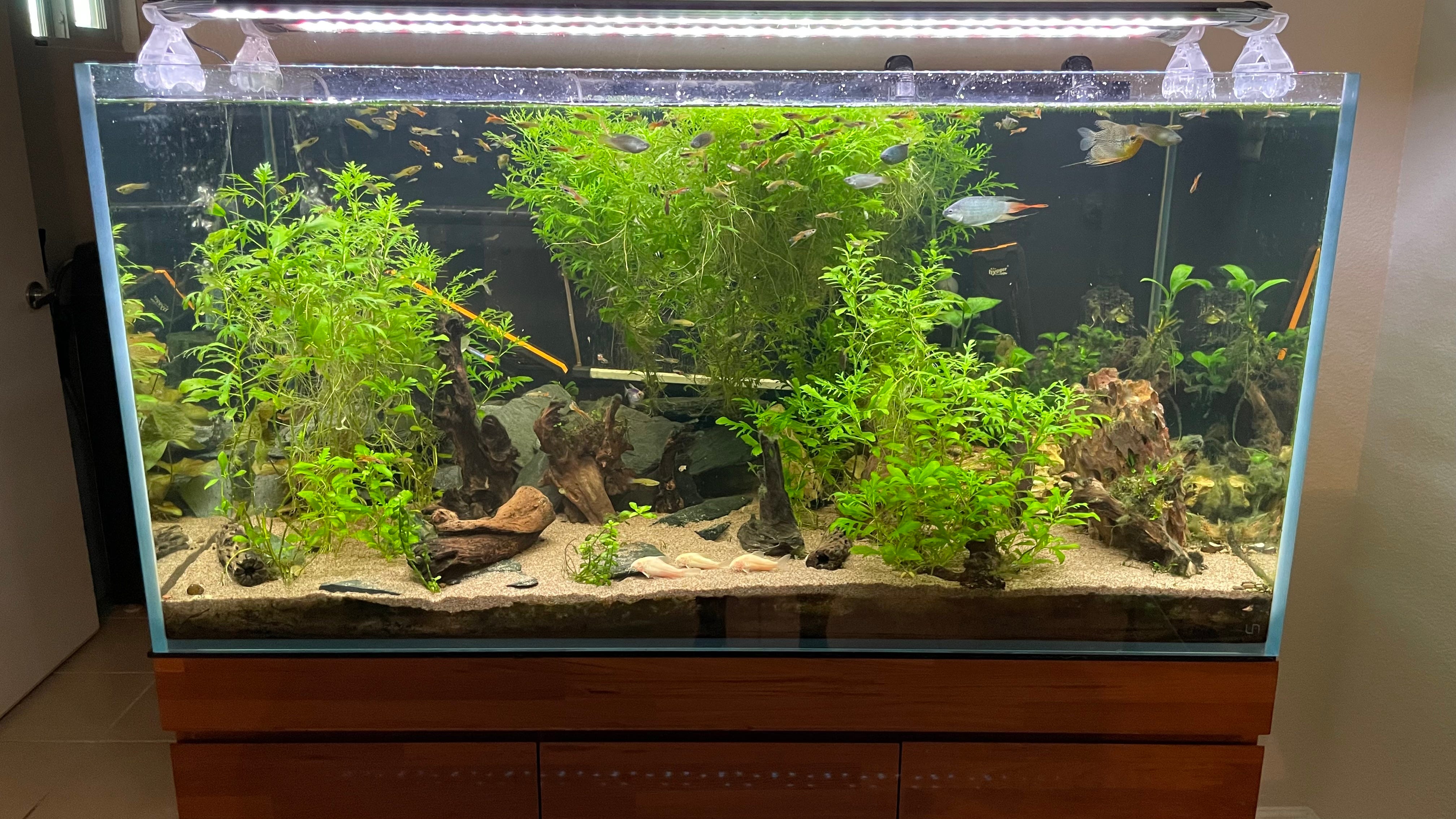
The 110-gallon. Riverbed scape with dragonstone, driftwood, and way too much water wisteria.
Plants: water wisteria everywhere. And I mean everywhere. It grows stupid fast, forgives mistakes, and actually does work for water quality instead of just sitting there looking pretty. Also got a red tiger lotus that blooms sometimes, some ferns I can’t kill, and duckweed on top because apparently that’s my life now.
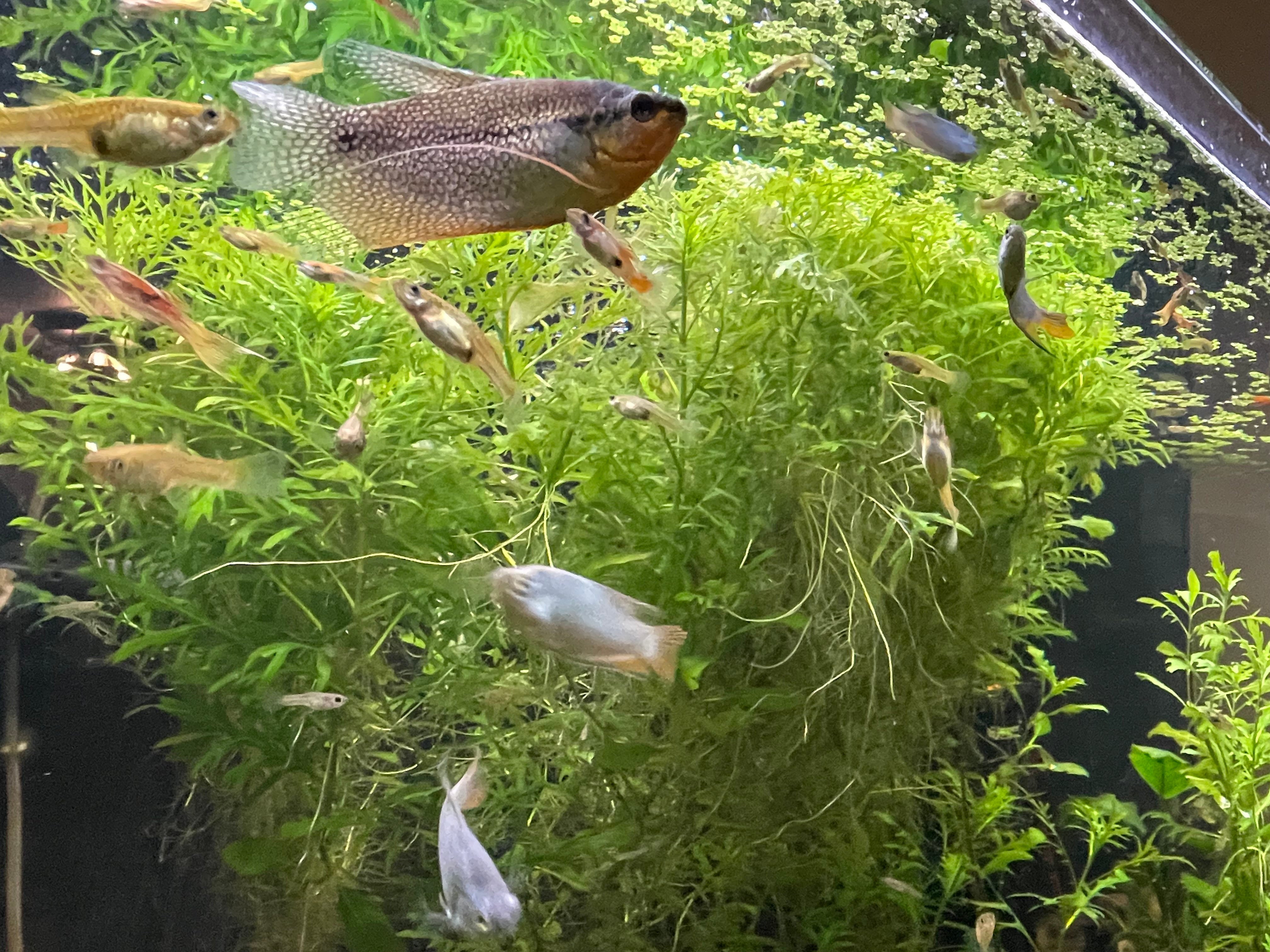
Water wisteria. It grows stupid fast and does actual work for water quality.
If you’re new and reading this, don’t treat this as a shopping list. It’s more like... a stability list. Everything here either makes the tank more forgiving or makes maintenance easier to actually do.
What I’m running on the 110
110-gallon UNS rimless with the matching stand. Looks clean. Cost too much. Don’t regret it.
Pool filter sand for substrate. Cheap, classic. Plus a bunch of dragonstone, slate, and driftwood I probably overpaid for at the LFS.
Plants are already covered: water wisteria (aggressive), tiger lotus (dramatic), ferns (indestructible), duckweed (mistake that I’ve accepted).
For filtration I overbuild on purpose because it makes the big tank way more forgiving. Sponge filter - simple, never breaks, just rinse it in tank water. Fluval 407 canister doing most of the work. Spray bar on the output so I’m not creating a hurricane. Plus a bubble bar for extra oxygen because I like bubbles.
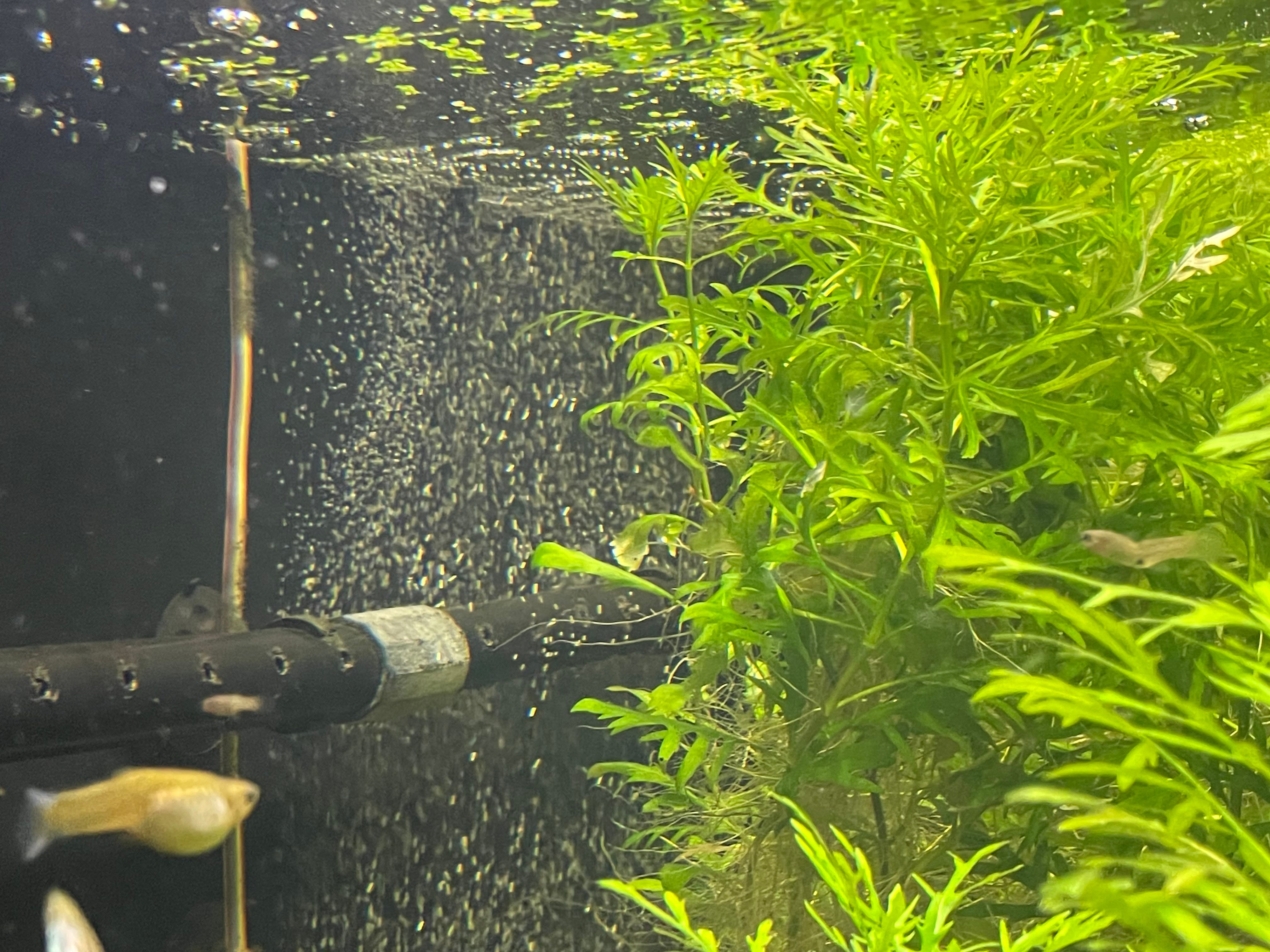
Spray bar setup. Spreads flow instead of creating a hurricane in one corner.(Yes, I have it lower than normal on purpose, ask me why)
The tank’s deeper than most standard setups, so I had to get air pumps rated for deeper tanks. Otherwise your sponge filter just sits there looking like it’s working while doing absolutely nothing.
Two 400W heaters set to 76°F. Running two keeps things consistent and if one dies I’m not scrambling.
Two Finnex planted lights on a timer. I run about 8 hours - well, 7.5 now because I kept forgetting to update the schedule after I shortened it during an algae outbreak last month. Also do a 30-minute sunrise/sunset ramp because it looks nice and the fish seem less freaked out.
I originally doubled up the lights because I wanted enough punch to reach the bottom of a deep tank. Looking back, I should’ve just bought one better light instead of two pretty-good ones.
Phoenix tap water. Heavily treated municipal supply. I always use conditioner because I’m not gambling with fish lives to save $12 a year. On the big tank I dose the whole tank before I start filling, then just run the hose. It’s easier than trying to dose 30 gallons in a bucket.
Food is a mix. Dry staple most days. Frozen brine shrimp and bloodworms as treats. I feed once a day, sometimes skip a day. Fish will act like they’re starving 24/7. They’re liars.
What actually keeps it stable
You can’t buy your way out of bad fundamentals. The tank cares what you do every week, not what you spent.
Get plants. Even easy ones. I don’t care if it’s just anubias zip-tied to a rock - put plants in there. Floaters especially. They suck up nitrates and make everything calmer.
Stock slowly. Painfully slowly. Add 3-5 fish, wait two weeks, check parameters, add more. I know it’s boring. Do it anyway.
Stop overfeeding. This is where everyone screws up, including me. Most mystery problems trace back to food rotting somewhere you can’t see. If the fish look hungry, they’re fine. They’re designed to look hungry.
When something goes wrong, I don’t start shopping for fixes. I figure out what I did wrong and stop doing it.
The routine (unglamorous and effective)
Daily: Feed. Watch the tank. That’s not a chore - that’s literally the point of having fish. I look at it from different angles because you catch stuff early that way. Wipe water spots off the rimless glass if they’re bugging me. Make a mental note if the wisteria is trying to conquer the entire tank.
2-3 times a week: Top off for evaporation. Arizona problems. Open-top rimless tank problems. It is what it is.
Once a month (ish): Clean the filters. And by “clean” I mean rinse the sponge and media in old tank water during a water change, pull out the gunk that’s blocking flow, put it back in. I don’t replace media unless it’s literally falling apart. That’s where your bacteria live.
When something looks wrong
I used to panic. Now I just run the checklist.
Check flow first. Is something clogged? Is there a dead spot?
Test ammonia, nitrite, nitrate.
Do a water change - even if the numbers look fine, it usually buys you time to figure out what’s actually wrong.
Then watch symptoms. Are they breathing hard? Flashing? Not eating? Hanging at the surface?
Lighting (how I stopped fighting algae)
Normal schedule: 7.5 hours of full light with a 30-minute ramp up and down. Then about 1.5 hours of blue “moonlight” at night because I think it looks cool. That’s for me, not the plants.
When algae starts showing up, I don’t run to the store for a magic bottle. I shorten the light schedule - drop to 6 hours if it’s bad. Lower intensity if I can. Manually scrub what I can reach. And check for dead spots in flow.
Dead spots are the sneaky problem. If you see debris settling in the same corner, or plants not moving, or algae always coming back in one spot - that’s flow, not light. Adjust the spray bar. Move some hardscape. Trim dense plant sections. Add a small airstone.
Most of my early mistakes were predictable: too many hours, too much light for the plants I actually had, and completely ignoring water movement.
Stuff I wasted money on
I’m not saying don’t buy gear. Just don’t buy it before you know you need it.
“Instant clear water” additives like Accu-Clear or Clarity. Cloudy water has a cause. Fix the cause. The bottle just masks it for three days and then it comes back.
Replaceable cartridge filters. You’re literally throwing away your biofilter every month on a schedule. It’s a subscription model for your bacteria.
Fancy biomedia. People will tell you Matrix or Seachem Pond Matrix or De*Nitrate is the key to everything. It’s usually not. Sponges and ceramic rings work fine.
CO2 injection before you can keep easy plants alive without drama. CO2 is great. It can also turn into a part-time job real fast.
Aquascaping tool kits on day one. Curved scissors, long tweezers, all that stuff in the YouTube videos. Buy tools when you actually need them, not because the unboxing looked satisfying.
Lily pipes and glass intake/outflow. They look fantastic on rimless tanks. They’re also fragile, expensive, and optional. Standard tubing works.
Your tank doesn’t care about expensive gear. It cares if you show up.
Water changes without dying
I try to hit 25% weekly unless something’s wrong, then I do more.
My current method is running a hose from outside through the back door. It’s as janky as it sounds. And I use an old wheeled cooler so I’m not hauling 5-gallon buckets like it’s CrossFit.
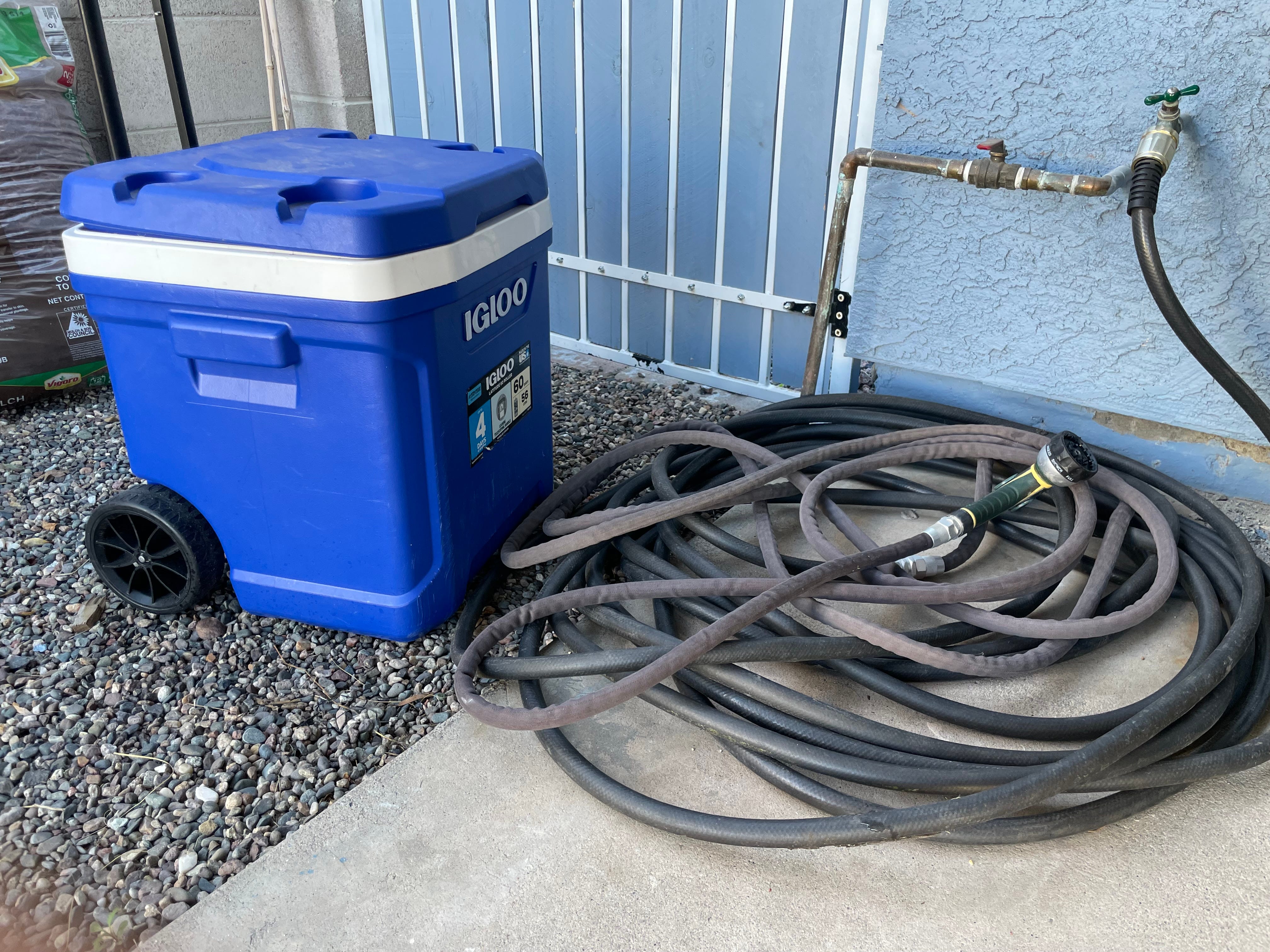
My water change setup. I run a hose from outside through the back door. Janky but it works.
Before this house I lived in a condo and used a sink attachment - basically a faucet adapter that let me hook up a hose and reach the tank. The method doesn’t matter. What matters is making it easy enough that you’ll actually do it every week instead of “planning to do it” for three weeks straight.
That’s it
If you want a tank that looks good and stays stable: build a system you can actually maintain.
Get plants. Stock slowly. Feed less than you think you should. Keep the water moving. Do water changes. The rest is just options.